
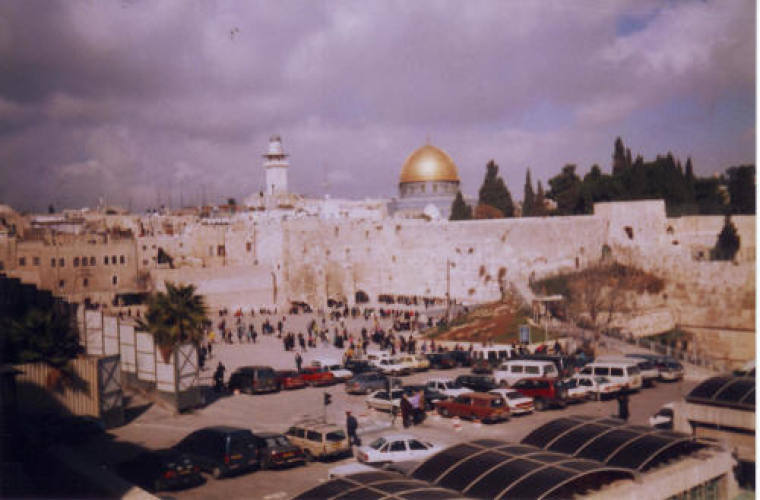
According to the Ynet-Gesher survey released in July reported by the International Christian Embassy Jerusalem (ICEJ), some 64 percent of Israeli adults surveyed, including about 47 percent of secular Israelis, said they would like to see the Temple in Jerusalem rebuilt.
http://www.assistnews.net/Stories/2009/s09070220.htm
Yet, this is the very sight of the Al-Aqsa Mosque which was built between 687 and 691 by the ninth Caliph (Abd al-Malik), the Dome of the Rock (or Qubbat As-Sakhrah) is one of the most famous Islamic mosques. It was built by the Caliph to honour Allah and some historians suggest that the scope of the temple's construction indicates that it was meant to rival Mecca.
At the center of the dome is a rock that is believed by Muslims to be the scene of Muhammad's ascension into the heavens. In the Jewish religion, the rock is the place where Abraham almost sacrificed his son, Isaac. It's also where Jews believe that Jacob saw the ladder into Heaven.
So the question remains, could the Jewish Temple ever be rebuilt on this site regardless of how many surveys showed that the Israeli's population wanted to see it happen.
A writer of Jewish matters, Baptist minister Mark Tronson, was one of a group of 48 international Gentile delegates invited to the 60th anniversary of the Liberation of Auschwitz in 2005 for the March of the Living. He is a qualified Holy Land tour guide through InnerFaith Travel and is a prolific writer against Replacement Theology, a doctrine where the Jewish peoples, post Christ's death on the Cross, play no further part in the economy of God.
M V Tronson suggests that by looking at the pages of literature and history, we see many examples of the most 'unlikely things happening'. He provides some examples to illustrate his views.
Pompii was completely destroyed in 2BC. Volcanic ash consumed a living city in one day! We've seen in our own era how a volcano can erupt and destroy everything in its path. Any tourist to Turkey who visits Ephesus along with those other ancient cities can view the destruction caused by earthquakes that occurred in the second and third centuries.
The defeat of Napoleon's army in Russia which it seems was probably due to typhus. More recent examples is the sinking of the Titanic, which was built as an 'unsinkable' ship. The amazing events surrounding the manufacture 'en masse' of penicillin during WWII, such that there was a dose for every Allied soldier who needed it on D-Day. This included finding a mould that produced much more penicillin, and moving the whole laboratory and procedures from England to America, and finding funding for it.
Another is putting men on the Moon. Moreover on 9 November 1989 the Berlin Wall the very symbol of the Cold War between the two super powers came smashing down. The landing of the plane in the Hudson River a few months ago with all on board saved is another. There are innumerable such examples of the most 'unlikely things happening'.
Mark Tronson says that anyone who says 'something cannot happen' has never even had a cursory glance at the pages of history, nor reflected on them.
"The likelihood of the Jewish Temple being rebuilt in Jerusalem on the site of the Dome of the Rock upon which the Al-Aqsa Mosque stands, is probably far greater than many imagine," M V Tronson concluded.
"History illustrates that natural disasters or the imaginations of man provide the means to achieve the most amazing things, good and bad."