
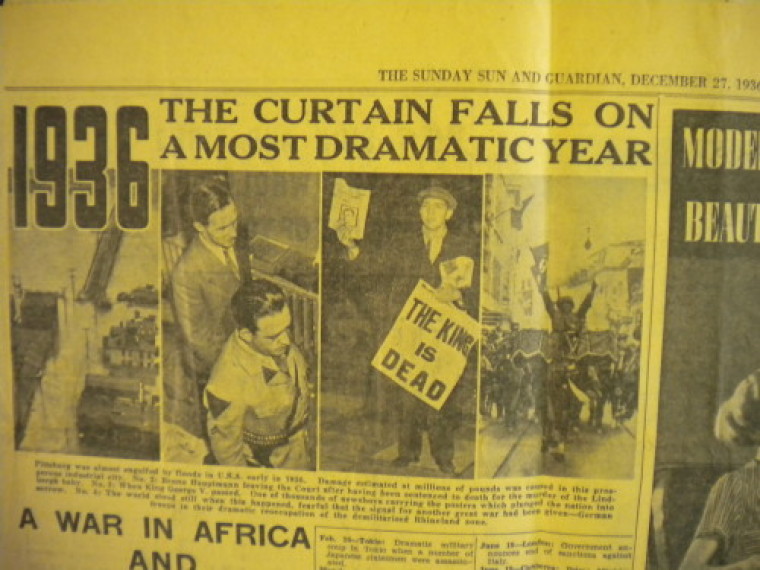
The article highlights some significant events of 1936, both in pictures and with a timeline of dates.
There are four photographs and descriptions of: Pittsburg floods in USA; Bruno Hauptmann leaving court having been sentenced to death for the murder of the Lindburg baby; the death and funeral of King George V; and German troops reoccupying the Rhineland.
I was fascinated that no Australian story made these pictorial headlines. It seems that, way back then, we really did have more of a 'cultural cringe' than we do now, with the general opinion that everything that happened in the USA or Europe was more important than events on our own shores.
Even when I was a child during the 1950s, I would hear people talking of England as 'home' even if they had never been there.
With the benefit of hindsight, I have selected a number of the 200 'major events' listed: 1936 was certainly a dramatic year. These, admittedly, show a wider range of domestic and international activities – including, of course, sporting news.
February 26: Tokyo – Dramatic military coup in Tokyo when a number of Japanese Statesmen were assassinated.
March 3: Durban: Australia wins the fifth Test: Grimmitt, 6 for 72.
March 12: Paris. French Senate ratifies pact with Soviet, which alarms Germany and Italy.
March 19: New York: 225,000 people left homeless in floods. One hundred million dollars worth of flood damage.
March 25: Gosford NSW: Six members of fishing party of 8 drowned when car ran into river at end of jetty at Davistown.
March 31: Berlin: Overwhelming vote for Hitler in general elections.
April 6: Abyssinia: Italians bomb Addis Ababa.
April 12: NSW. Four drown when car runs into water at Manning River at Tinonee near Taree.
April 23: Morocco: Man dies at the age of 140.
May 12: Geneva: Italian delegates walk out of the League of Nations.
May 21: London. Death of Lord Allenby, the liberator of Jerusalem, at age 75.
June 16: New York. German boxer, Joe Schmeling knocks out negro, Joe Louis.
June 19: Canberra. Prime Minister Lyons announces the manufacture of aircraft and aeroplane engines in Australia.
June 25. Tokio. Japan restricts wool, wheat and flour imports from Australia following restrictions of rayon imports by Federal Government.
July 10. Melbourne. Sir Thomas Blamey, Police Commissioner, resigns his position following enquiry into shooting of Superintendent Brophy.
July 18: Sydney. England beats Australia in third Rugby League Test, thus retaining the series win.
August 1: Berlin. Berlin Olympic Games open spectacularly.
August 22. Canberra. Commonwealth proclaims Australia's acceptance of 3 million square miles of the Antarctica.
August 27: Sydney. Work starts on Circular Quay Railway.
September 27. London. France, Britain and USA reach currency agreement. French devalue their franc.
October 16: Belgium. King Leopold startles Europe declaring neutrality.
October 19. Sydney. 12 out of 14 drown when 18ft launch sank in Hawkesbury River.
November 4: Melbourne. Melbourne Cup won by NZ bred Wotan at 100 to 1.
November 4: New York. Roosevelt has overwhelming victory in Presidential election.
November 5. Madrid. Fall of capital to Franco announced as imminent.
November 12: San Francisco. Bridge over the bay is opened. 24 lives were lost during construction.
November 23: Sydney. Wool prices rise 25% on quotes sat opening sales.
December 1: London. Three million people watch destruction of famous Crystal Palace.
December 2: London. The Bishop of Bradford, Dr A W F Blunt, rebukes King Edward VIII.
December 9: Brisbane. England wins first cricket Test by 322 runs.
December 11: London. King Edward VIII abdicates and King George VI proclaimed.
December 22: Sydney. England wins second Test match by innings and 22 runs.
Seventy-four years into the future, someone will look at the archives or old internet sites and look back at what their parents and grandparents were doing and thinking in 2010, and note what national and international events that were significant.
It is interesting to me, as a historian, to note how we as humans are very bad at predicting what may be 'good' or 'bad' events. At present, the Western world thinks it is important for democracy to be introduced into cultures around the world. It is seen to foster peace and harmony. However, one of the events during 1936 was the overwhelming democratic victory of Hitler.
What do we make of this in the light of history, now? What will our children and grandchildren make of international events of today, in another 74 years, 2084? It is not for us to know.
Hopefully, Christian ministers will still be able to criticise the Heads of State and/or our political leaders as Bishop Blunt did.
I note that in recent years there has been discussion by Christian leaders of various denominations about stem cell research on embryo cells, the new class of abortion drugs, gay marriages and the introduction of Ethics classes into NSW schools for those children who do not attend religious instruction.
Let us hope that in 74 years' time, these open discussions can continue, as they did in 1936.