
The hard covered diary took two forms. The first type of diary is a journal written by professional people who recorded daily details, for example, the captain of the Endeavour Captain James Cook or the Australian explorer Charles Sturt or scientists recording their observations.
The second type with which we are all familiar, is the secret personal diary of an individual, a diary that was kept hidden, as highlighted by Anne Frank the Dutch Jewish girl recording her thoughts as the Nazi's occupied Holland.
Many Australians were accustomed to writing diaries, sometimes from loneliness since it could take a year or more to get an answer to a letter from a relative in England.
These now have historical reference points in politics, in the pioneering of farming communities, in how religious congregations developed, and more notably during the two World Wars, where there are literally thousands of examples of those at Gallipoli, the Middle East and the Western Front as well as from the battlefields of WWII.
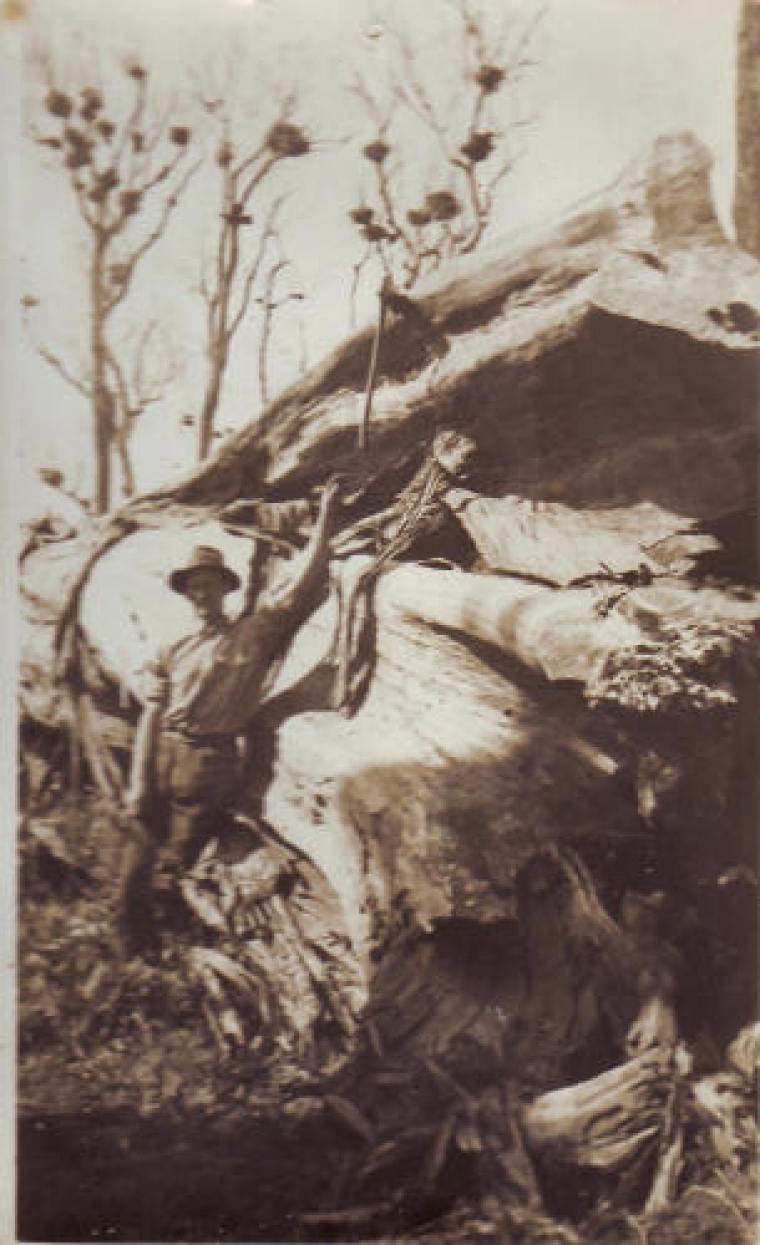
M V Tronson points to his own father's diary as he pioneered the Crediton farming district west of Mackay (Great Diving Range, Eungella), Queensland in the 1930's.
Seymour Tronson's diary illustrates in remarkable detail how he cleared the land and established a dairy, is now on-line; along with diaries of his mother which document the personal strain and some tribulations of a 'city girl' having to adapt to bringing up a new baby 'out bush'.
http://bushorchestra.com/family_logo/life_of/TronsonBiographySeymour.html
"It has been said numerous times in recent years that journal writing is a lost art, yet I tend to disagree with that assessment, as the diarist in my view, is still well and truly alive and kicking, but just using different methodologies," M V Tronson suggested.
He points out that whereas parents of the baby boomers became expert at taking splendid photographs to record their children's development for posterity, and the baby boomers used home videos, the most recent generations of parents have upgraded to using their mobile phones and miniature digital cameras and MP4 players and recorders to 'capture the moment' exactly when it happens.
"We remember sending to each set of grand parents a video, twice a year, with each of the children giving a report on their activities," M V Tronson explained. "Now, the grandchildren and grandparents can see and hear each other every day, if they wish, even on opposite sides of the world, with webcams and online technology."
Diarists, also, can today use a range of several communication arenas to allow their scribblings to be seen and read.
Many families now keep Blogs which record events, photographs and videos. Social networking is another form of diarist recordings, such as Face Book, My Space, U-Tube and numerous others. The Internet itself with its search engines is another place where diarists can record their stories. Wikipedia for example, hosts many people's autobiographical details.
Radio and TV programs are embracing the new ways of communicating electronically. Most of those that would formerly take articles by post now have online methodology in place, where members of the public can submit stories in text, photographs or video.
The ABC also has a website called Pool, where anyone can register and place text/visuals of all types/ audio files, or comment on others' pieces, or contribute to discussion on the various forums. http://www.pool.org.au/
Even in the mainstream ABC 'Radio Australia' network, M V Tronson's story of his pioneering Chaplaincy to Australian Sport from the early 1980's has been submitted and recorded in answer to requests for segments suitable for their program, 'The Making of Modern Australia'.
http://makingaustralia.abc.net.au/_Chaplaincy-to-Australian-Sport/BLOG/217397/73526.html
Together, these segments can form a type of community diary (albeit one that has been selected and edited by the ABC staff).
Yet, there are still many Australians who keep a written or computer-generated diary. Some may be surprised by this, but inveterate scribblers often like the touch and feel and pace of a favourite pencil and smooth paper, or the quicker touch of a keyboard.
One generic group in this category is the clergy; Ministers, Pastors, Priests and others need to keep meticulous records of their pastoral duties along with personal reflections.
"Keeping records has always been an essential part of my ministry. In 1999 it was these that ensured that there was more than enough evidence to stymie certain political intrigues that were underfoot," M V Tronson reflected.
"Having witnessed the benefit of accurate records, since 2000, I have gone further, and written a thorough daily account of my ministry, including phone conversations."
Mark Tronson recommends anyone who has a responsible community role to ensure that their daily activities are recorded, dated, and have reflective comments added. The added benefit is that reflection on the successes and disappointments of your day can help you gain a positive perspective in planning what you will do tomorrow.