
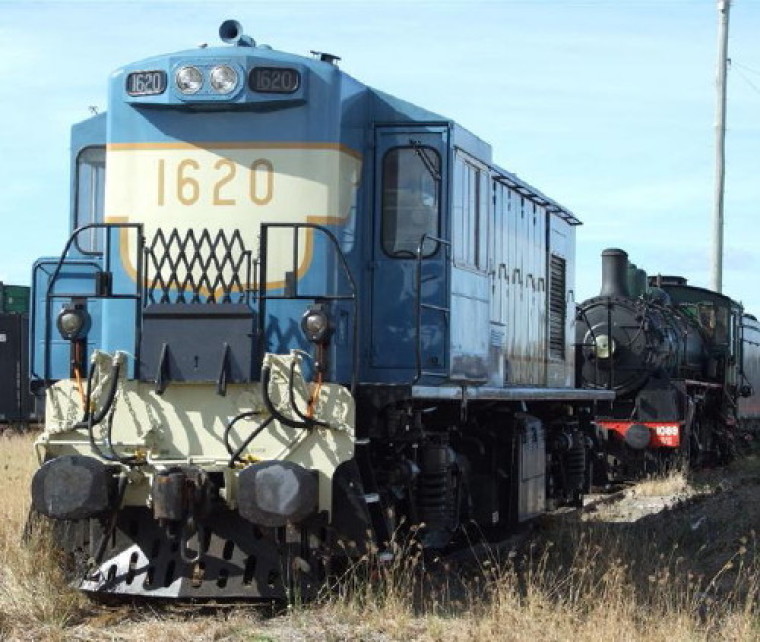
He recalls that in his years as a locomotive engineman, steel trains climbing the Summit Tank to Robertson track (New South Wales south coast line Unanderra to Moss Vale) were required to have a minimum of two 1,800 horsepower diesels for a load of 1,200 tons. Guards were responsible for the train not being 'over the load'.
Depending how much 'over the load' a train is, there could be a range of serious consequences. For example, the train might make a slower trip, thus running behind the timetable and blocking the trains coming on behind; or it might get stuck on a hill so that the train needs to be split with the first half taken to the next station and stored, then the second half brought in later.
Any way you look at it, the result is a huge delay all round.
"A story entitled 'Over the load' written by contributor Bill Hawke in my 1992 book 'Steam Stories' is about a guard named 'Bluey' in the Gulf country in far north Queensland who worked trains from Alma Den to Forsayth," M V Tronson noted.
Under steam haulage, a train arriving at Einasleigh had to reduce its load for the train to get over the Newcastle Range. This required a shunting operation. When there were enough of these 'left off' wagons to constitute another train, then there would be a Saturday run over the range to collect these orphan wagons.
"Bill Hawke explains that in this section of railway line, which was almost exclusively freight, timetables were considered to be a little 'fluid': what you might lose on the hill you would pick up on the flat," Mark Tronson related.
The story is set in the early fifties when the first 'diesel' came and the driver noticed that over the first week of running over the range, the diesel laboured and lost a 'little time' each trip.
He thought this was a little strange and asked Bluey the guard if there was a reason for it. Bluey assured the driver that nothing was amiss, so the driver put it down to the fact that the diesel was not as good up hills as was the steam engine for the same train weight.
On the Friday the driver asked Bluey what time should they be signing on Saturday to take over the range those 'orphan' wagons. "No need", was Bluey's response, "we brought them over each day of the week, we can have tomorrow off!"
Bluey had judged that the diesel could haul a little more than the steam engine, so he manipulated the system in order to have Saturday off, something that was greatly desired by all. Moreover, Bluey booked in his paper work for the Saturday train, as if they had worked.
There is a strange dichotomy here. Trains were not late. QR got its wagons to Forsayth. The men had their Saturday off, yet the Saturday was claimed (otherwise they would have had to fight through red tape for months).
"There are a number of very strange stories not unlike this in the Bible, (Jacob & Esau; Joseph from prisoner to PM; Balaan; David & Goliath; Jesus healing on the Sabbath) which in a roundabout way, gives me confidence that the Bible is as true to life as is Bluey's story," M V Tronson mused.