
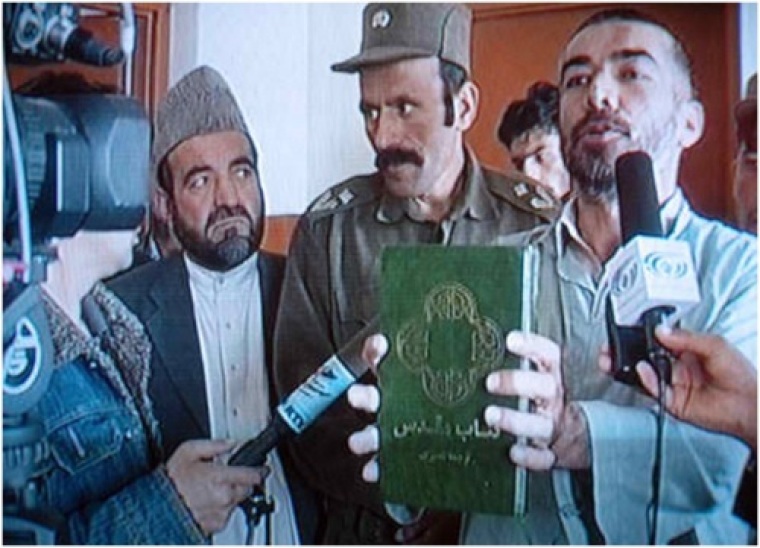
In the last few years, hundreds of Afghans have converted to Christianity. At the same time converting to another religion, in a country like Afghanistan, with 99% of the population being Muslim seems very hard. Afghanistan is a country with one of the strongest Islamic fundamentalism and extremism ideologies.
Islam is the heart of this country and for an Afghan everyday life is centred on religion. Once a person in Afghanistan leaves Islam, he or she will face consequences that are sometimes very hard to imagine. Converts lose their family, friends and are rejected by society. They not only face social pressure but also harsh legal consequences that include the death penalty and loss of all civil rights.
Many believers leave their homes and country because of the overwhelming persecution of being a Christian in Afghanistan. "Between 200 and 250 Afghan converts from Islam to Christianity who feared persecution from the Afghan authorities and the Taliban have found refuge in Delhi." (india.blogs.nytimes.com)
In my article today we will look at just one of the aspects of the persecution towards believers in Afghanistan. Let's examine the legal status of those who convert from Islam to other religions.
What does Afghan law says about converting?
The constitution of Afghanistan does not address a penalty for conversion to Christianity from Islam. Chapter 1, Article 2 of the constitution talks about religion this way: "The religion of the state of the Islamic Republic of Afghanistan is the sacred religion of Islam. Followers of other religions are free to exercise their faith and perform their religious rites within the limits of the provisions of law." (afghan-web.com)
In Article 6 the constitution promises the implementation of human rights, which implies the freedom of religion and belief. "The state is obliged to create a prosperous and progressive society based on social justice, protection of human dignity, protection of human rights, realisation of democracy…" (afghan-web.com)
Looking at these articles in the constitution is the good news, but the problem is that it still does not mean that there is freedom of religion in Afghanistan. There is a contradiction in the constitution towards this issue. Afghanistan in one way tries to implement democracy and human rights, but on the other hand, it is an Islamic state which views different values as a threat.
This contradiction arises in the Chapter 1, Article 3 of the constitution: "In Afghanistan, no law can be contrary to the beliefs and provisions of the sacred religion of Islam." (afghan-web.com)
As we see there are two different laws in the same constitution, one promising human rights and the second preventing any law that is against Islamic law. Since almost every judge in the country is pro-Islamic law, the court will always use this element of the article to punish Christian converts.
Now the only possibility of freedom of religion in Afghanistan is for Islam to give this freedom as constitutionally guaranteed.
The Quran
Islamic law and theology are predominantly founded upon two main sources: the Quran and the Hadith. The Quran gives various teachings about freedom of religion and apostasy. Many verses talk about the consequences of apostasy in the afterlife and gives instructions for punishing those who abandon the Islamic faith.
The thrust is about those who refrain from Islam and thus creating chaos to the wider society. The fear of any new ideology. Some of the verses that promote the freedom of religion such as: "And if they submit [in Islam], they are rightly guided; but if they turn away - then upon you is only the [duty of] notification. And Allah is seeing of [His] servants. (Quran 3:20).
Now, there are other verses that teach tolerance and freedom of belief. But, on the other hand there are many verses that teach punishment such as - exile, imprisonment and even death to those who leave Islam. This is a contradiction in Quran. The fundamentist Muslim lawyers use these verses that order the death penalty for apostate behaviour.
"They wish you would disbelieve as they disbelieved so you would be alike. So do not take from among them allies until they emigrate for the cause of Allah. But if they turn away, then seize them and kill them wherever you find them and take not from among them any ally or helper."(Quran 4:89).
The Hadith
The second primary source for Islamic law is the Hadith. The Hadith has been transferred orally generation by generation, which finally hundred years after Muhammad's death has been bought together and written down.
In Islam when the law cannot find any clearly defined direction about an issue in the Quran, then this second resource, the Hadith is referred to. The Hadith is the action and teachings of the prophet Muhammad.
This is an example of the Hadith, where it orders the killing of a person who was Muslim and is found to be someone who no longer believes in Islam.
"Allah's Apostle said, "The blood of a Muslim who confesses that none has the right to be worshipped but Allah and that I am His Apostle, cannot be shed except in three cases: In Qisas for murder, a married person who commits illegal sexual intercourse and the one who reverts from Islam (apostate) and leaves the Muslims." (usc.edu, Sahih Bukhari, Volume 9, Book 83, Number 17)
The Hanafi is one of four Jurisprudence schools in Sunni Islam founded by Abu Hanifa (699-767) which is practised in Afghanistan, whereby they seek clarification from Quran and Hadith. Their interpretations on this issue of death to apostates from Islam is critical in Islamic law.
By looking at Afghanistan law and Islamic law we see that all of the converts in Afghanistan can legally be killed by such jurisprudence adjudications. Many are waiting to see what will happen to this country when International forces pull out, which is a process that has already begun. Hundreds of believers in Jesus Christ are in peril in this country which is in desperate need of prayer.
Mumin Faizy is a young Christian from the Middle East (Islamic world) and his interest research areas are philosophy and religious studies. We cannot show you his photograph.
Mumin Faizy previous articles may be viewed at www.pressserviceinternational.org/mumin-faizy.html