
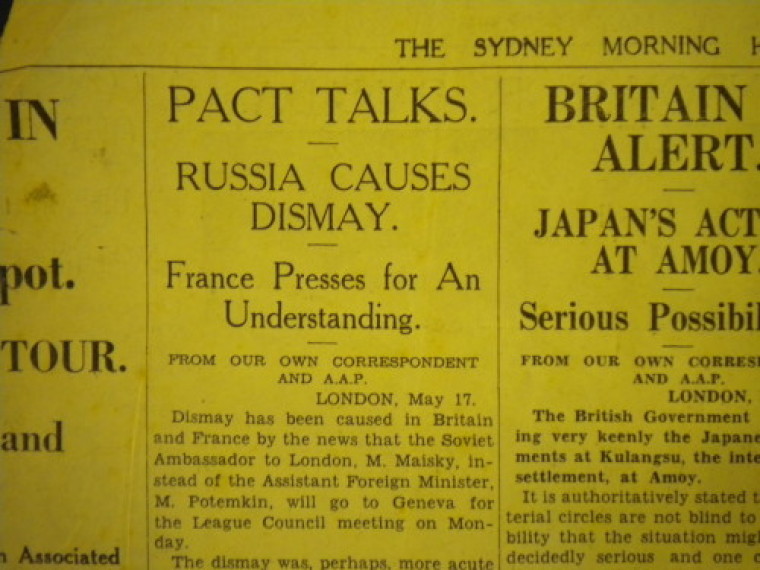
For example, I recently came across an article dated 18th May 1939 from The Sydney Morning Herald which was entitled: "Pact talks – Russia causes dismay – France presses for An Understanding".
European events throughout 1938-39 were drawing closer and closer to belligerency between the major players with Germany being seen as an aggressor; and the allies Russia, France and England each playing 'hard ball' over specific issues.
My mother was an avid reader of current political issues and wrote about them in her private papers (which we still have in the family archive). This subject of Russia playing political games must have fascinated her and therefore we can assume it was kept for future reference.
The article starts off: "Dismay has been caused in Britain and France by the news that the Soviet Ambassador to London, M Maisky, instead of the Assistant Foreign Affairs Minister, M Potemkin, will go to Geneva for the League Council meeting on Monday. (Referring to the League of Nations, the forerunner of the United Nations).
"The dismay was, perhaps, more acute in France, which yesterday sent the British Government a communique suggesting that, as a possible solution to the diplomatic impasse, Britain should join her and Russia in a tripartite mutual assistance pact."
It appears as though there was an attempt to remodel the original Franco-Russia Alliance into an agreement for mutual aid in the event of either country being involved in war arising out of any anti-aggression schemes. This was code for the feared aggression by Germany, which was already 'on the march' through Europe, and Hitler's designs on Russia were well known.
The AAP commentator makes this summary: "Britain would then be involved in war through the Franco-British alliance, since, if France became involved in war by helping Russia against an act of aggression, she would automatically come to the assistance of France."
The correspondent makes the point that Russia does not favour such an outcome but discussions between the British Foreign Secretary, Lord Halifax, and the French Foreign Minister, M Bonnet would produce better impressions.
The rest is history. All this politicking came to naught. Russia wasn't ever intending to be part of a European deal with France and England. Eventually, a week before Germany invaded Poland (1 September 1939) they signed a non-aggression pact with Hitler with the secret protocol to divide Poland.
In addition, Russia took political control of the Baltic States. Although it lost them in the initial stages of WWII when Hitler invaded Russia, it resumed control after Germany was defeated by which time Russia was indeed one of our Allies. For Stalin, this was a far better long term deal than coming to a deal with tricky France and even more trickier England whose foreign policies had been honed over several hundred years.
The Old Testament's recording of nation state's land grabs and land retention is full of politics. The Old Testament books of I and II Samuel, I and II Kings and I & II Chronicles illustrate the nature of the political wheeling and dealing. There should be nothing surprising therefore with what occurred in Europe and Russia the late 1930's.
An interesting side issue with all this, is that I'm aware that many national anthems are actually battle-cries – asking the Lord to help the nation be victorious. The French La Marseillaise for example, which was originally "The War Song for the Army of the Rhine" and the 'Star Spangle Banner' of the USA which comes from "Defence of Fort McHenry",a poem written in 1814 by the 35-year-old lawyer and amateur poet Francis Scott Key, after witnessing the bombardment of Fort McHenry by the British Royal Navy ships in Chesapeake Bay during the War of 1812.
(en.wikipedia.org/wiki/The_Star-Spangled_Banner)
However, I was surprised to find that the British national anthem which I had always thought of as asking the Lord to protect the Monarch, also asks The Lord to help the Nation to defend itself, both politically and militarily. The little-heard second stanza of "God Save The Queen (or King)" has these phrases referring to 'trickery':
O Lord, our God, arise,
Scatter her enemies
And make them fall.
Confound their politics,
Frustrate their knavish tricks,
en.wikipedia.org/wiki/God_Save_the_Queen
It seems that it is an universal desire for all peoples to try to settle their disputes with political solutions, and if these do not work, they resort to hostilities. It was these events my mother as a young woman must have been watching with interest, in the lead-up to World War II.