
Author of sixteen railways books, Baptist minister Mark Tronson who is also the Footplate Padre, thinks that the current situation is confusing, to say the least. The former livery system of State run railways was not only tried and true, but provided a kind of certainty.
They evoked a nostalgic pride in each State's diesel and electric locomotive fleet, as well as providing clarity for the station staff in knowing which train to direct, and certainty for passengers in knowing which train to catch.
The West Australian passenger service from Kalgoorlie to Perth had green livery carriages with a green diesel locomotive with red trim.
The Commonwealth Railways 'Trans-Continental' across the Nullabor had a dark maroon and silver band, while the famous 'Overland' that ran overnight from Adelaide to Melbourne hosted an aluminium silver and light maroon livery, the same as the South Australian Government Railway diesel locomotives.
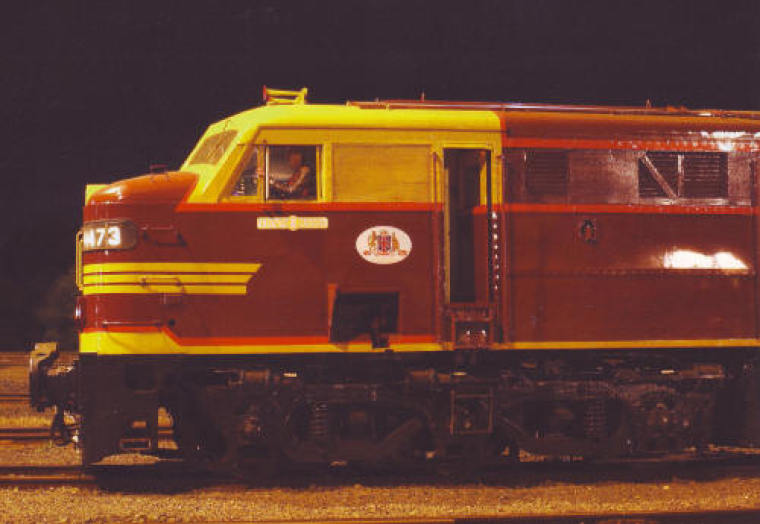
The 'Spirit of Progress' was dark blue with a yellow stripe, as were the Victorian Railway diesel and electric locomotives, while all New South Wales trains – engines and carriages - sported the russet red with yellow trim.
Queensland Railways, keen to represent the Sunhsine State, decked out their whole trains with classic blue and white through until the late 1980s, when the corporate colour scheme (Brisbane Broncos colours) of maroon and yellow was established.
South Brisbane railway station was for many years the terminus for New South Wales trains, whose livery was very different to Queensland locomotive livery. This proved very helpful for signalmen who guided standard gauge New South Wales diesels across the narrow Queensland gauge in train manoeuvres.
Numerous rail enthusiast photographs show Queensland blue and white diesels beside the russet red New South Wales diesels in the South Brisbane shunting yards, providing clear and unequivocal documentation as to which was which.
Now however, each separate railway company or consortium railways has its diesel or electric locomotives painted in its own specific colour scheme. That same NSW and Qld shunting manoeuvrer now sports company locomotives with the same livery but on different line gauges. How confusing is that?
It is not unusual to view photographs in the various railway magazines that show a train hauled by five diesel locomotives, each decked out in a different livery. With the modern era of railway operations, it is not uncommon for companies to lease the power units (locomotives) to run their trains. When company trains require additional power units, the leasing system takes no notice of colour or livery pattern.
With more and more private ownership of the locomotives, each organisation naturally wants to display its own corporate colours. Mark Tronson thinks the cost must be phenomenal.
When Patrick closed its doors to railway operations, their fleet of locomotives with their bright shiny livery of red with yellow trim were given a new makeover by their new owners. Some diesels have boasted several different new sets of 'clothes'.
There is an obvious answer to the question, 'who ultimately pays for all this?' According to Melbourne's newspaper The Age, the cost of changing a Logo is the same cost of a whole new train. M V Tronson agrees costs are way out of whack.
"I advocate a cost-saving measure," says Mark Tronson. "Establish a system of State depot based liveries. If a locomotive is designated as based in Queensland, the livery is blue and white, full stop. If it is based in Victoria, it is dark blue with the yellow trim, and so on, regardless of which company or consortium owns it."
As the Footplate Padre M V Tronson advocates that simplicity, ie: 'less is more' conveys more specific and better information, which follows the Gospel story of Jesus' death on the Cross for our sin and His resurrection as our assurance of Salvation.
"One of the best forms of communicating important truths is through simplicity for memory. The Gospel story has conveyed this through all these centuries. As a minister of 32 years I am no longer astonished of this. Therefore, this principle can be applied elsewhere," M V Tronson explained.