
However he acknowledges that Israel seems to have benefited more than Palestinian Christians from finances from the western world – in both political and religious realms.
M V Tronson, who has an interest in the holy land having led tours and written extensively on this subject, realises that there are valid reasons for this.
He cites the massive sympathy and perhaps guilt felt by Europe after the Holocaust, leading to the United Nations establishment of the State of Israel; the acknowledgement of the bravery and commitment of the new Israeli settlers during their 1948 war of independence, the 1967 six day war, and the 1973 Yon Kipper war; and the seemingly senselessness of terrorist attacks such as Palestinian rockets being fired into Israel, suicide bombers, and other ongoing conflicts.
The post-war world watched in awe and admiration as Jews from the Diaspora forged the State of Israel and turned its deserts into fields flowing with milk and honey; this inspired many western evangelical hearts to renew their teaching on Israeli's return to their ancient land, fulfilling many Biblical prophecies and burgeoning a new interest in end times scenarios. There was a real need to finance such evangelism, which also led to the witnessing of Jews recognising Jesus as Messiah.
The cause for Israel is unmistakably bound up in Christian heritage, which is the heritage of most of the western world that was dominant in world affairs after World War II. The Bible is full of promises to Israel. With the clear unequivocal claim that the Lord is the same yesterday, today and tomorrow, it is therefore not unreasonable that Christians have been directing funding to Israel.
Millions of dollars have poured into these coffers. M V Tronson, himself, has been part of this, with his leading Holy Land tour groups, joining the March of the Living at Auschwitz and explaining in his writings why Replacement Theology is not consistent with Biblical Prophecies.
However, there is a case for better finance for evangelism relating to Palestinian Christians. "The answers for this are never simple," realises Mark Tronson, adding: "They are more than likely to be bewildering."
He realises that 'history is written by the conquerors', and to redress this, perhaps more regard could be taken of the Christian Arab viewpoint of some of the events surrounding the establishment of Israel. He notes that there is a belief that the Palestinians are well funded by their oil-rich Arab neighbours, and moreover the stated aim of the Palestinian political system is to destroy Israel and push every Jew into the sea.
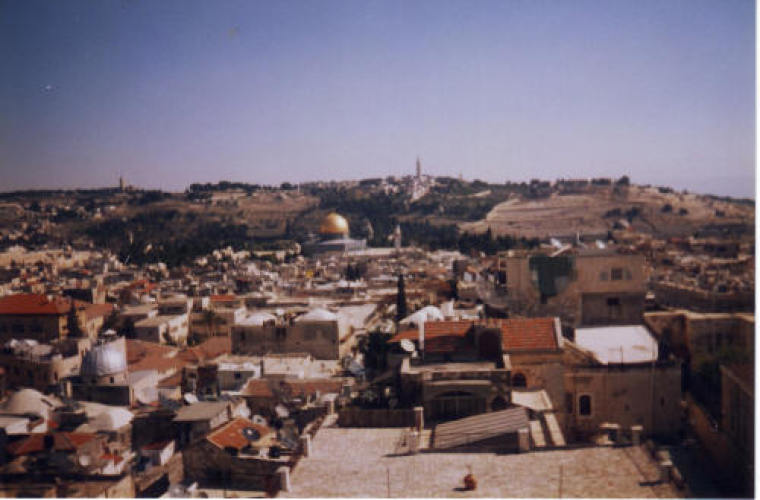
But, it should be noted that there are thousands upon thousands of Christian Palestinians – there is a recognised 'Christian Quarter' in the Old City of Jerusalem, equivalent to the Jewish, Arab and Armenian Quarters.
"Had even a semblance of this funding been directed to Palestinian Christians to finance missionary outreach according to Matthew 28:19, the nature of the Palestinian nationalistic aims may have been influenced differently," wonders Mark Tronson.
He quotes: Psalm 145: 18-19 - "The Lord is nigh unto all them that call upon Him, to all that call upon Him in truth. He will fulfil the desire of them that fear Him: He also will hear their cry, and will save them".
M V Tronson is unmistakably zealous for the evangelism of Jews, and things 'Israel'. He is equally zealous that the Salvation message of Jesus reaches every people group, whatever their cultural or religious background. That includes the Palestinians and others in the Middle Eastern region – a region which has seemingly been less attractive to missionaries who have willingly travelled to 'other' far-flung parts of the globe.
But for this evangelical Christian, speaking from the benefits of a middle-class Anglo-Saxon culture, a better recognition of Matthew 28 verse 19 for all people and groups seems to be a way forward in evangelism.
Evangelism funding from the better off - for the less well off - regardless of nationality, will be the only way to win the Palestinian people to Christ. This is the critical issue.