
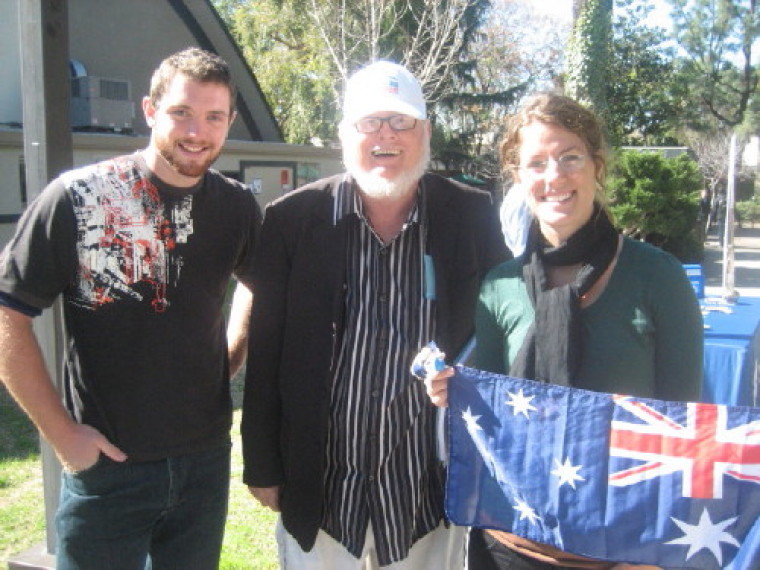
|PIC1|His reflections have made him realise the universal instincts in all people. Those in the clergy do not act 'differently' from others, and these observations could equally as well apply to those in any club-room, board-room, building site or family dinner table within our society.
In this specific example, 'territory' is a considerably wider issue than two Christian ministries where cross-over of residential boundaries occurs. It can also refer to someone who feels another minister is encroaching upon his professional or intellectual territory.
"As a local minister in a small Sydney Baptist suburban church in the later half of the 1970's, I realised that there were unspoken ethical procedures that were followed," M V Tronson recalled.
"Sheep-stealing was considered very bad form, whether practiced across the boundaries of my fellow Baptist ministers in neighbouring churches, or those of Christian ministers from the other denominations in my area."
However, with the increasing charismatic-type evangelistic churches during the eighties, all these gentlemanly protocols seemed to change irrevocably.
"Now, thirty years later, results from a variety of surveys and statistics gathered about church attendance point to a trend of decreasing loyalty by Christians to any local congregation, or even one denomination," M V Tronson noted. "With increasing mobility, people feel free to pick and choose a type of service or pastoral style that suits themselves and their family best."
The phenomenon of highly publicised evangelistic churches which provide many different activities have in effect, been remarkably successful marketing campaigns largely focusing on the name of the visionary minister or pastor.
"However, Christian agencies such as the Bible Society, Youth With A Mission, Fusion, Scripture Union, the Chaplaincies (Industrial, Hospital, Military, Youth and Community, Prisons, Universities, Professional Sport) and a myriad of others have all exhibited remarkable stability" M V Tronson has observed.
These organisations which rely on outsourcing of Christian ministries have gone against the 'populist' trend of the eighties.
A question, M V Tronson asks, is why have such Christian agencies not followed the populist trend? First he says, it relates to the 'formal community accreditation' that is required, and secondly, the restricted nature of how funding can be spent.
"An entrepreneurial minister or pastor in this more modern form of 'church' spends the money where they believe the Holy Spirit is leading, whereas a formal community accredited agency operates within set parameters," M V Tronson explained.
But this also brings another question raised from those same Church Life surveys, that this modern form of 'church' has its own Achilles heel, where someone with a bit of entrepreneurial gall hangs out their shingle and then Humpty Dumpty is seen to be alive and well.
"This is where 'territory' becomes a pastoral issue for the staunch and true Christian minister or pastor who sees the faithful move to such adventurous enterprises and are then left putting back-together the disillusioned," M V Tronson mused.